
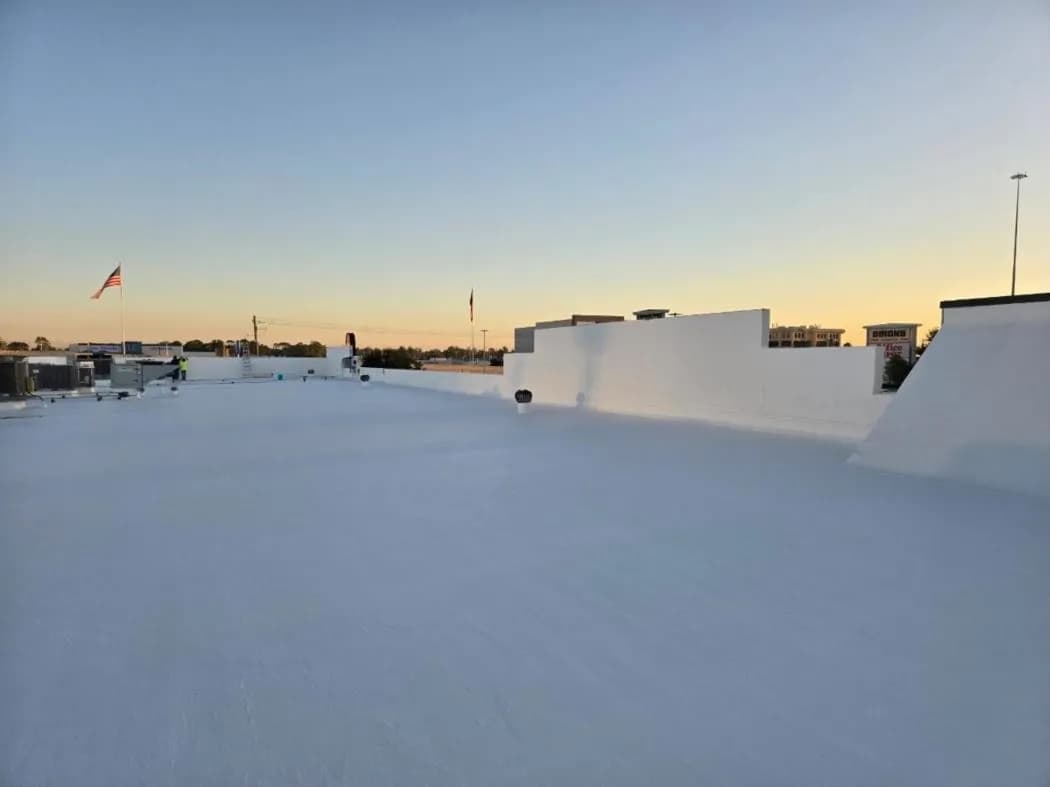
10303 Katy Freeway: 30,000 SF of Gravel Roof, Renewed in Place
A commercial building on the I-10 corridor gets its gravel-surfaced roof spudded smooth and brought back under a seamless fluid-applied system — with every tenant open for business underneath it.
The challenge
Commercial property on the Katy Freeway corridor has a specific problem: the building has to keep earning while the roof gets fixed. This one is multi-tenant, it stayed fully operational, and its parking lots stayed full. That made the real challenge a coordination problem rather than a roofing one — working with every tenant, staging equipment and material without taking the parking they need, and keeping the job quiet and clean enough that the owner’s phone did not ring with complaints.
The roof was the familiar gravel-surfaced built-up assembly. Under the aggregate, the membrane had reached the point where patching was no longer buying anything.
A big challenge is the smooth coordination with the gravel removal company. We had to ensure that we could spud at the same pace they could remove the debris.
What we did
The gravel was removed during the day while at night spud machines were used to remove embedded asphalt. The vacuum company then vacuumed the loose debris. We followed this process until completed. The big challenge was that the roof had a lot of piping which prevented us from using the machines. We had to hand spud those areas, significantly slowing down the process. Once the surface was spudded smooth, we installed a fluid-applied system across the full 30,000 square feet. The existing roof still had structural value as a base, so it stayed and became part of the new assembly.
A truck-mounted commercial vacuum lifts the loose aggregate off, spud machines break out what is embedded in the asphalt below it, and then the crew vacuums again and hand-spuds the remainder until the surface is smooth enough to bond to.
Communication was very important so that the occupants understood that in order to have a roof without leaks, there would be noise, especially during the spudding. Fortunately, only one of the tenants was open at night so the impact on tenants was lessened.
Why it matters for the owner
No tear-off means no disposal cost, no crane time and no tenant disruption beyond the crew on the roof. For a property where every day of interruption is a real number, that is usually the deciding factor.
The finished surface is white and reflective, which in Houston is a measurable reduction in cooling load on a 30,000 square foot footprint — and a straightforward thing to put in front of a tenant or a buyer.
One note on upkeep: a white roof only saves energy while it stays white. Houston air puts dirt on a reflective surface over time, so plan on washing the roof every four to five years to hold it at maximum reflectivity and efficiency.
Have a roof like this one?
Harvest restores commercial roofs across the Houston area — fluid-applied roofing and waterproofing over metal, single ply, modified bitumen and gravel-surfaced built-up systems. If your roof is aging and you want to know what it actually needs, we will come look at it.
Harvest · (281) 259-7099 · office@teamhis.com · harvestroofs.com
You may also like
 Read More
Projects & Case Studies
Star Cinema Grill: 45,000 SF Over Mod Bit, and Not One Show Cancelled
A theatre roof has one constraint that outranks all the others: quiet. Here’s how we restored 45,000 square feet without closing an auditorium or interrupting a showing.

 Read More
Projects & Case Studies
CityCentre Convention Center: 40,000 SF of Mod Bit in the Middle of a Busy District
A modified bitumen roof in one of Houston's densest mixed-use districts, restored in place — with high-rises on every side and an event space that had to stay open.
 Read More
Projects & Case Studies
Gulf States Toyota: 109,000 SF of R-Panel Metal, Coated End to End
Our largest metal roof restoration — more than two and a half acres of R-panel coated end to end, with the distribution facility running normally the entire time.