
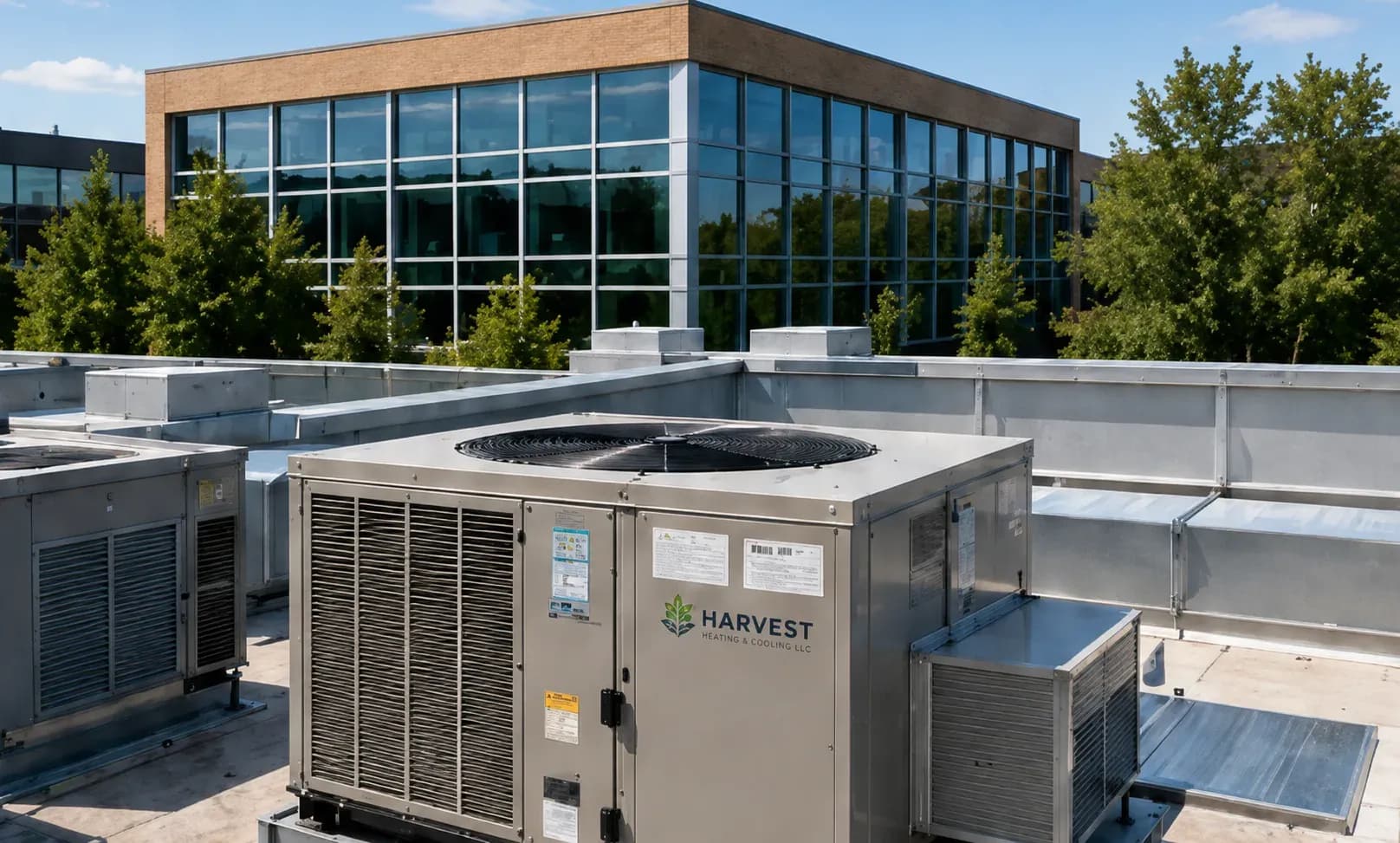
How to Evaluate Continuous Air Treatment in a School HVAC Project
A practical framework for school owners and consulting engineers: how to trace every claimed saving from airflow to equipment to construction cost, without relying on unsupported promises.
Most schools buy HVAC equipment and indoor air quality technology as separate purchases. The mechanical design is set first, and air treatment is priced afterward as an add-on. That order hides the most valuable question: could continuous air treatment change the equipment the school has to buy in the first place?
Start With Two Designs, Not One Percentage
The owner should ask the consulting engineer for two transparent designs: a conventional, code-compliant design with no CIMR® credit, and an optimized design that includes only the changes the engineer accepts. Each claimed saving should trace back to an equipment schedule and a contractor's price, never to a generic "X% reduction."
CIMR does not eliminate the need for outdoor air. Ventilation is still required for pressurization, exhaust makeup, CO₂, odors and contaminants the strategy does not control. ASHRAE 62.1, ASHRAE 241 and the adopted mechanical code still govern the design.
From Airflow to Equipment
In a hot, humid climate like Houston, every 1,000 CFM of outdoor air the engineer approves removing represents about:
- 4.9 tons of cooling capacity (59,300 Btu/h)
- 33.9 lb/h of moisture removal
- 37,800 Btu/h of winter heating
At 5,000 CFM, that is roughly 25 tons and 170 pounds of moisture per hour, enough to change coil size, compressors, reheat and humidity-control sequences.
Not Every Saving Is a Capital Credit
- Direct: dedicated outdoor-air coils, compressors, reheat and dehumidification, valid when approved outdoor air and design load go down.
- Threshold-dependent: rooftop unit size or count, chiller modules, cooling-tower cells, pumps and electrical service, valid only when the load crosses a selection threshold.
- Conditional airflow: fans, motors, VFDs and main ductwork, valid only when total airflow drops, not just the outdoor-air share.
- Secondary construction: electrical, structural, roof curbs and phasing, valid when tied to a revised equipment schedule.
- Deferred: smaller equipment at the next replacement, for existing buildings whose equipment stays in service.
What It Costs Over Ten Years
For a 100,000-square-foot elementary school with about 900 students, the model assumes a $250,000 CIMR installation, replacement cells every three years ($187,500 total), and $45,000 for power, service and monitoring. That is about $482,500 over ten years.
Three Owner Scenarios
- Conservative: $150,000 in avoided mechanical cost, a 5.7-year payback on the remainder, $96,830 10-year net value (20.1% ROI).
- Reasonable engineering: $250,000 avoided, which fully offsets the installation; $286,830 net value (59.4% ROI).
- Higher engineer-verified: $375,000 avoided, giving the school a $125,000 capital advantage from day one; $541,830 net value (112.3% ROI).
All three use the same conservative attendance and maintenance value, so a better engineering case never inflates the health assumption.
A Deliberately Conservative Attendance Benchmark
The model borrows a 24.6% reduction in infection-related absences from a 2025 meta-analysis of school hand-hygiene programs. That works out to roughly 664 recovered student days and $22,933 a year. It is not a CIMR-specific result. Anything above it is treated as upside until the district measures its own data.
Value the Model Leaves Out
Teacher and substitute costs, parents' missed work, academic continuity, athletics and locker-room conditions, and fewer room closures or emergency cleanings are not included in the dollar figures. Each of them makes the case stronger, not weaker.
Timing Matters
The capital case is strongest for new construction, major renovation or equipment replacement, when the optimized load changes what is purchased today. In existing buildings, the value shows up as lower energy and peak demand, better humidity control, less equipment stress, and smaller equipment at the next renewal.
Before You Decide
Share attendance records, maintenance work orders, utility bills, equipment age and capital plans with your engineer. Define who is responsible for cell replacement, monitoring, fallback ventilation and commissioning. Then compare the two designs side by side.
These are simple, undiscounted planning projections, not guaranteed savings or measured CIMR results.
You may also like
 Read More
October 27, 2026 | Air Quality
Can Schools Improve Indoor Air Quality While Reducing HVAC Costs?
A New Approach to School Facilities, Student Health, and Long-Term Investment School districts face a difficult challenge: creating healthier learning environments while managing rising construction costs, energy expenses, and limited budgets.

- Read More
May 14, 2026 | Air Quality
UV, Bi-Polar Ionization, or Better Filtration: Can these systems compare to CIMR?
Not every air quality technology works the same way — or comes without tradeoffs. Here’s a look at other common engineering controls.
 Read More
April 9, 2026 | Air Quality
Sick Building Syndrome Is Costing Schools More Than They Think
Indoor air pollution has ranked among the top five environmental health risks since 1990. Here’s what that actually means for a school building.